Closing tricks don’t help bigger sales
In Neil Rackham’s study of about 35,000 sales calls, classic closing techniques went with fewer sales in bigger ones. It’s one large, old study, and the guide says so.
Run sales calls you’re not embarrassed by: prepare in ten minutes, say your price out loud, ask for the work and stay in touch without chasing.
A step-by-step UK guide with a call plan, question bank, objection notebook, after-the-call messages, a pipeline tracker and AI prompts. No closing tricks and no made-up statistics.
Ask a founder why they put off sales calls and you’ll hear the same thing. They don’t want to be the person who rings every day, talks over you and won’t take no for an answer. I don’t want to be that person either, and the best research on bigger sales suggests you don’t need to be.
This kit is for the calls you already have: people who know your work, enquiries and referrals. It doesn’t cover cold calling. It covers preparing, asking better questions, saying your price, asking for the work and staying in touch afterwards, with the UK rules you need. Where a number comes from a software company or a point is only my view, I say so.
In Neil Rackham’s study of about 35,000 sales calls, classic closing techniques went with fewer sales in bigger ones. It’s one large, old study, and the guide says so.
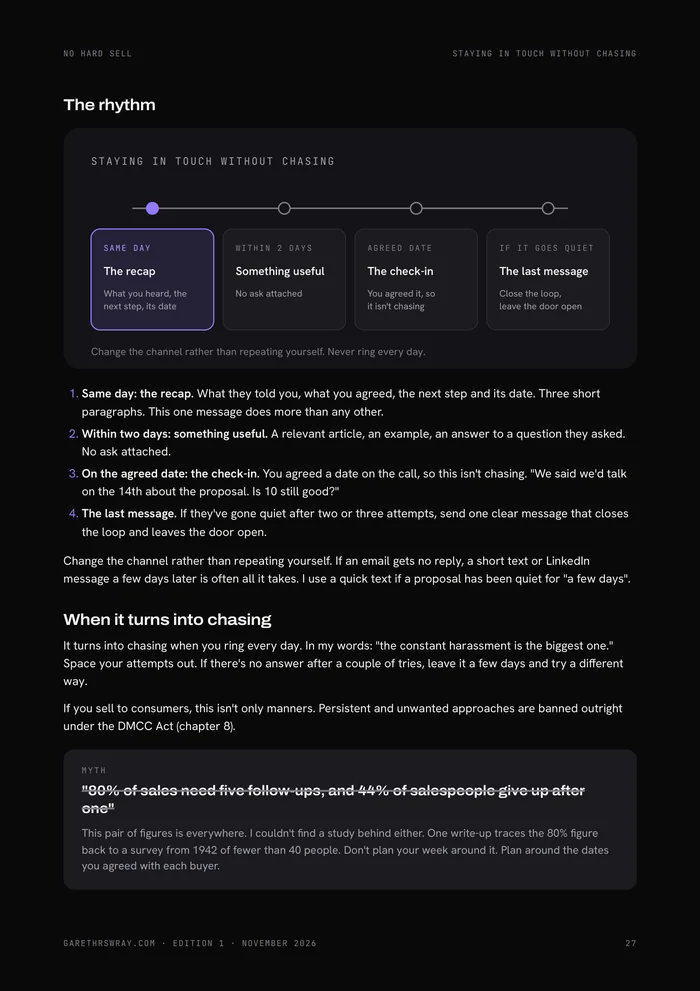
I couldn’t find a study behind “80% of sales need five follow-ups”. One write-up traces it to a 1942 survey of fewer than 40 people.
The 43:57 talk ratio is Gong’s 2016 figure. Its 2025 vendor data shows sellers talked about 57% on won deals and 62% on lost ones, and Gong calls the gap small.
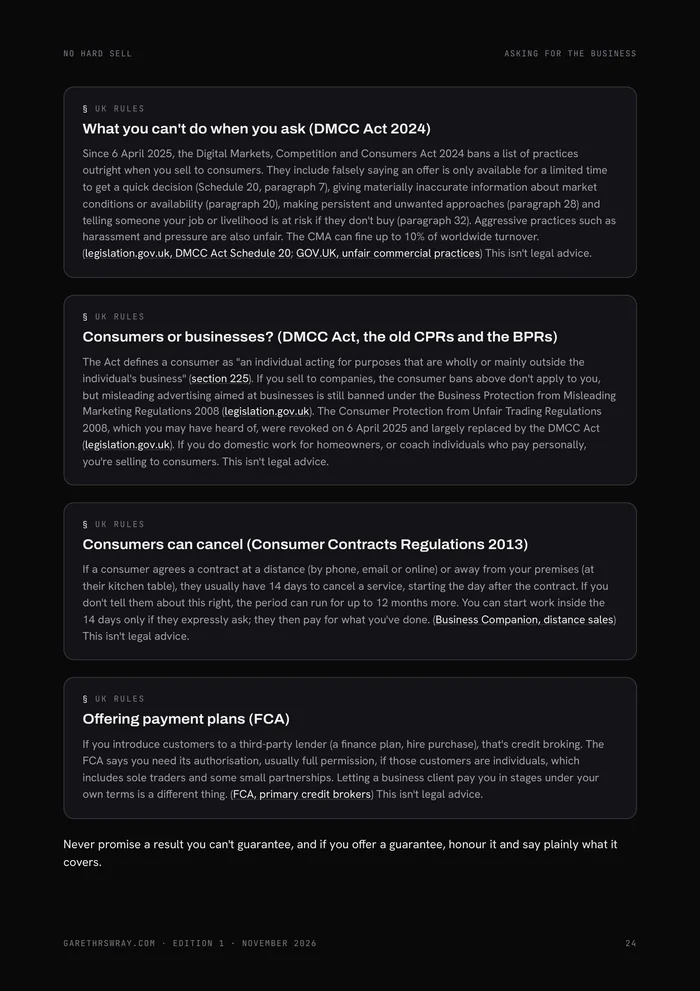
Since 6 April 2025, fake deadlines and persistent unwanted approaches are banned outright when you sell to consumers, under the DMCC Act 2024.
What’s in it, how the weekly pipeline review works and how to get it. The words are on screen, so it makes sense with the sound off too.
Everything downloads straight after you pay.
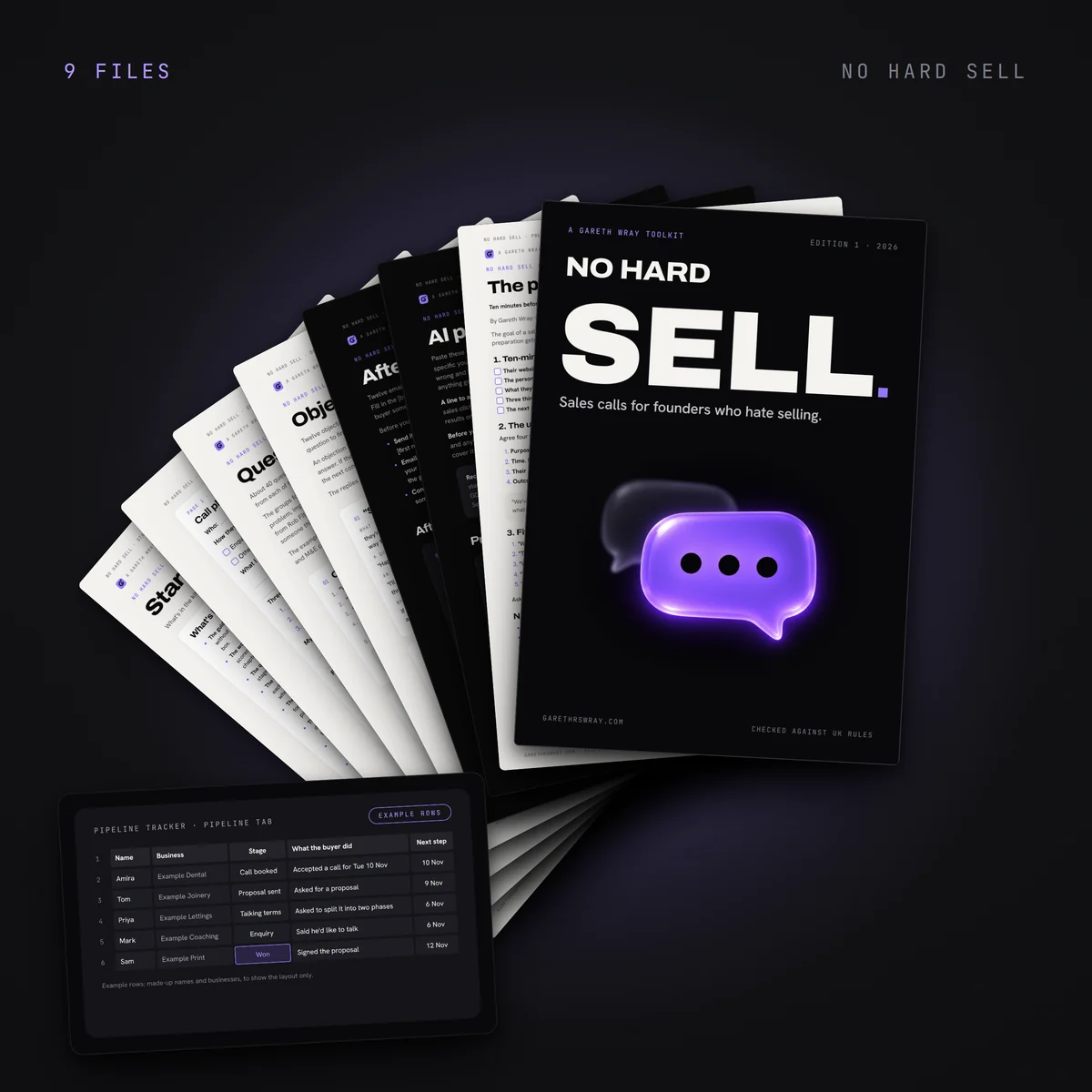
A one-page map of the kit, the order to use it and your first 30 days.
Preparing, the first two minutes, questions, saying the price, objections, asking for the work, staying in touch, your pipeline and getting better.
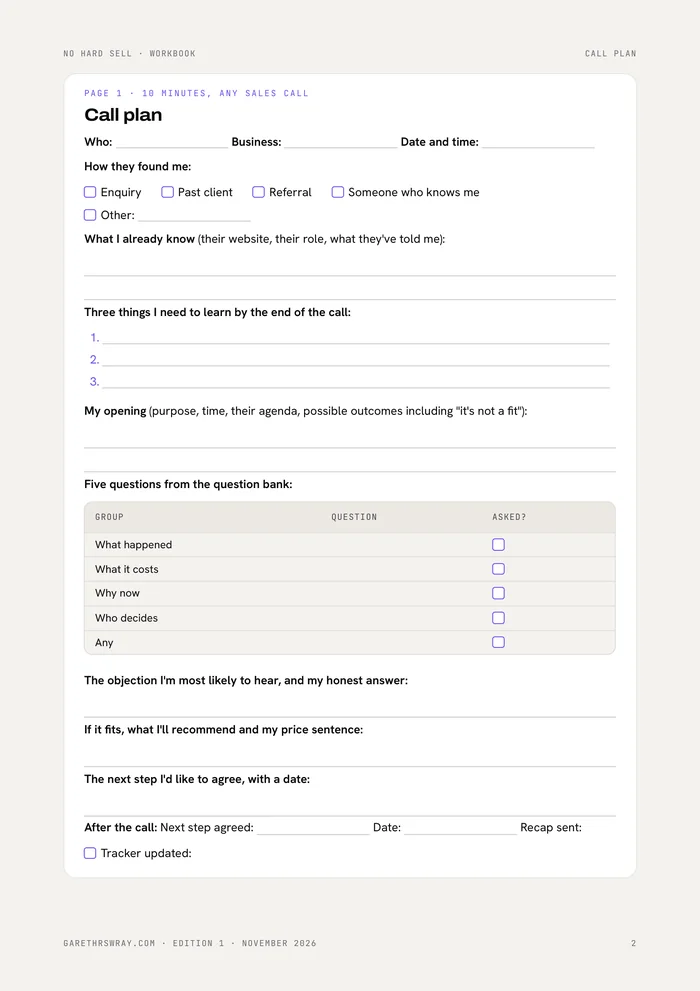
The one-page call plan, the call scorecard and an exercise page for six of the chapters. Type into it or print it.
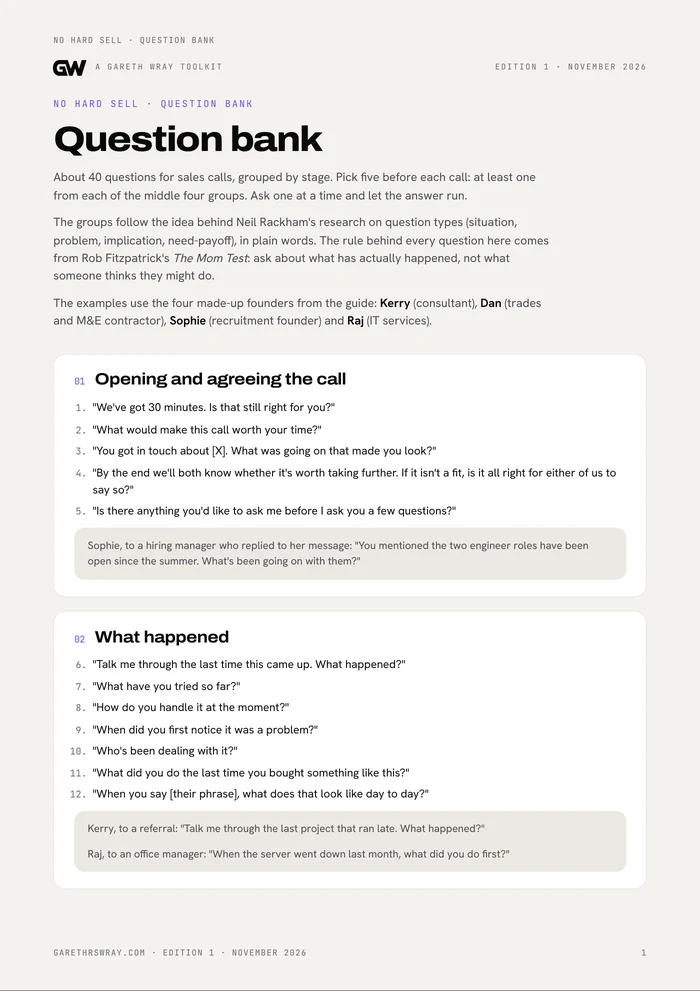
Grouped by stage of the call, with examples, plus the questions to avoid.
What each one might mean, a question to ask, an honest reply and when to let go. Plus a page for your own.
Emails and texts for after the call, after the proposal and closing the loop, plus a one-page proposal outline.
Stages defined by what the buyer has done, your own numbers and a 20-minute weekly review. For Excel or Google Sheets.
Prepare, rehearse with a role-play buyer, review your own call notes and check your drafts. Check everything they give you.
The ten-minute prep on one page. It’s also free, so pass it to anyone you know who dreads a sales call.
The Start here page is a one-page map of the kit: what each file is for, the order to use them and your first 30 days, a chapter or so at a time. Read it first and you’ll know where to begin.
The guide and workbook covers carry your name, so it reads as your copy, ready to print or keep on screen.
Every file was opened and tested on 1 November 2026. The workbook fills in on screen; the tracker is for Excel or Google Sheets.
Tap any page to see it full size. Want a free sample first? Get the pre-call sheet.
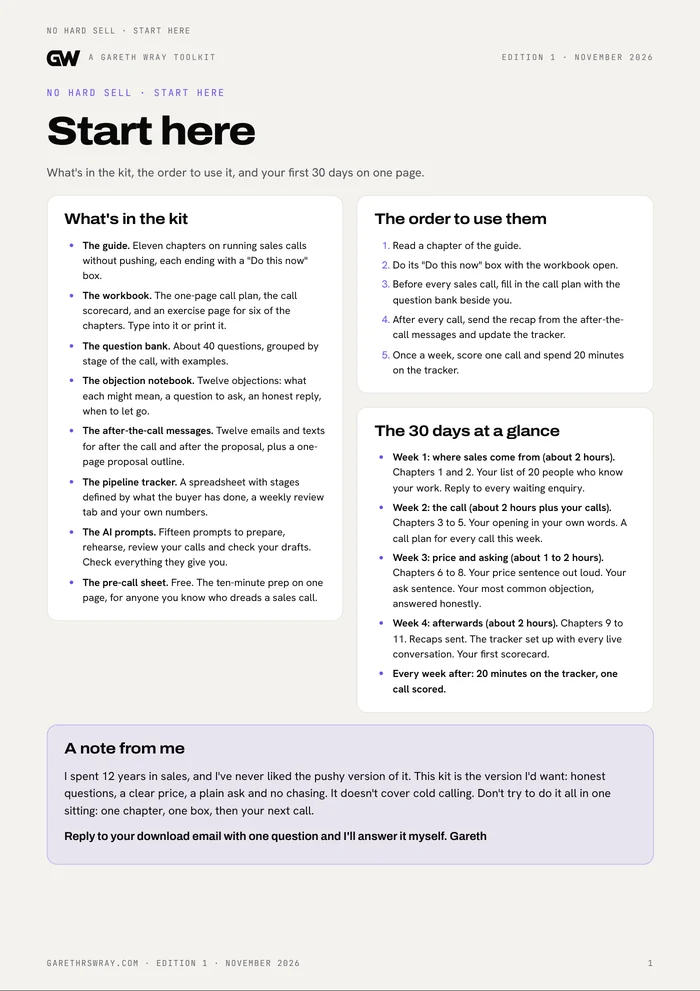
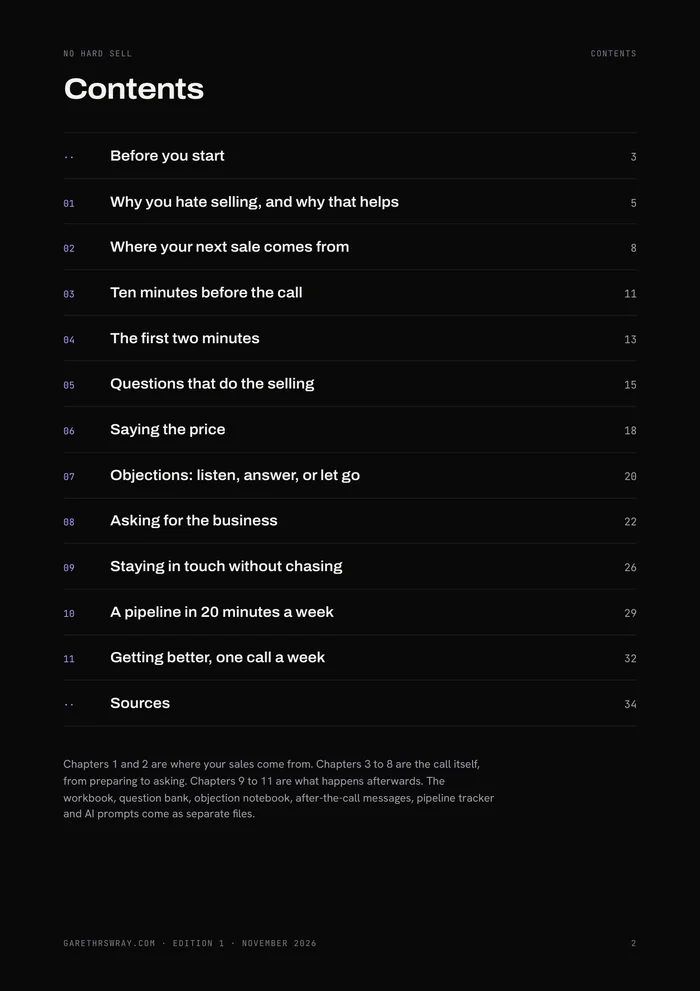
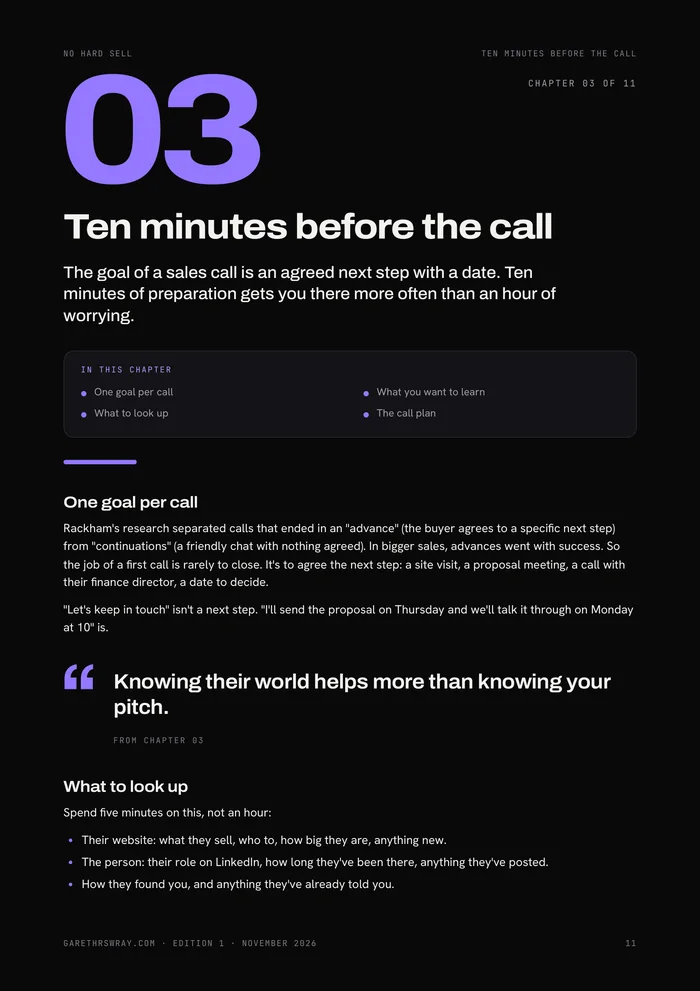
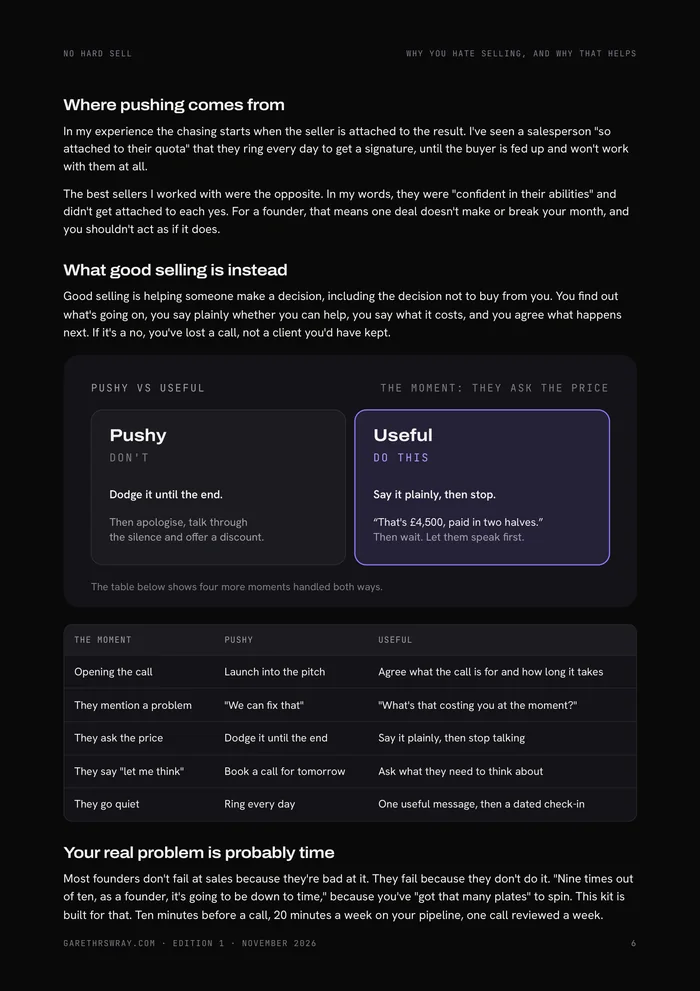
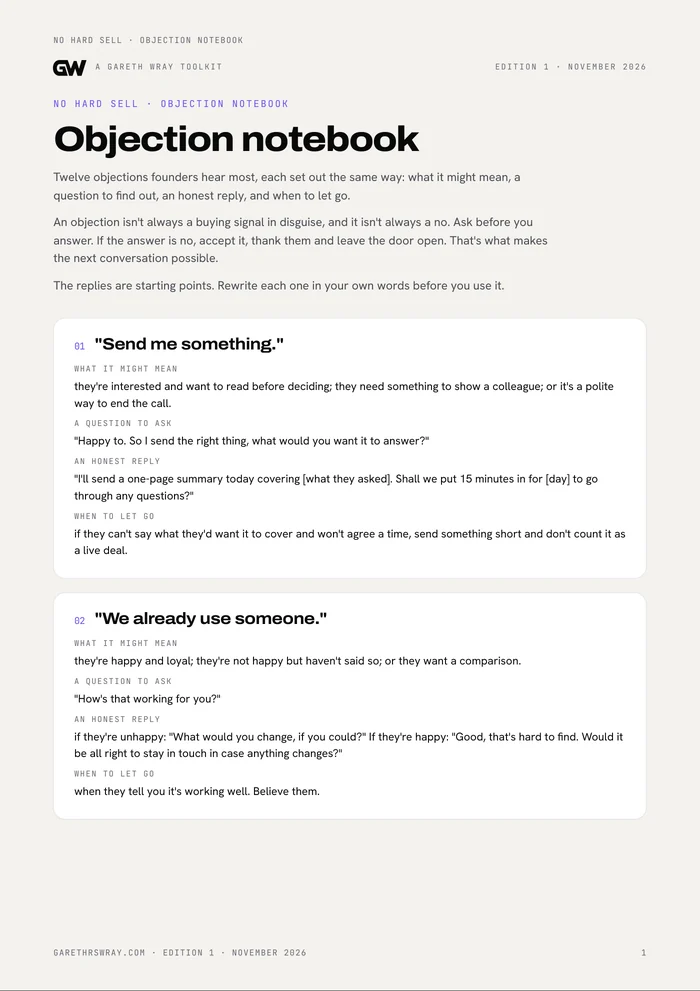
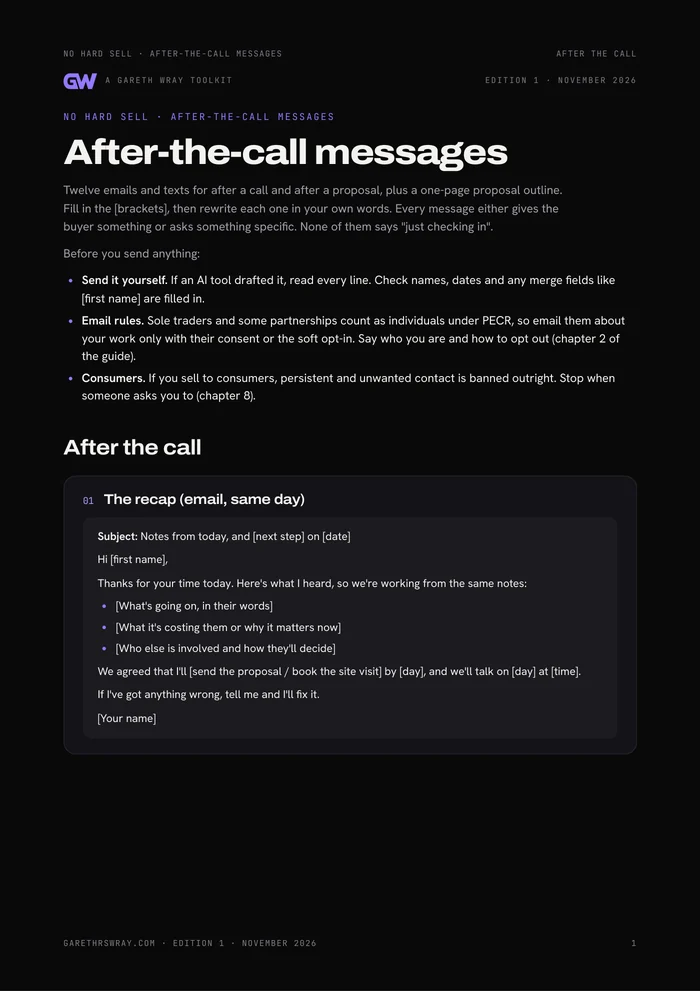
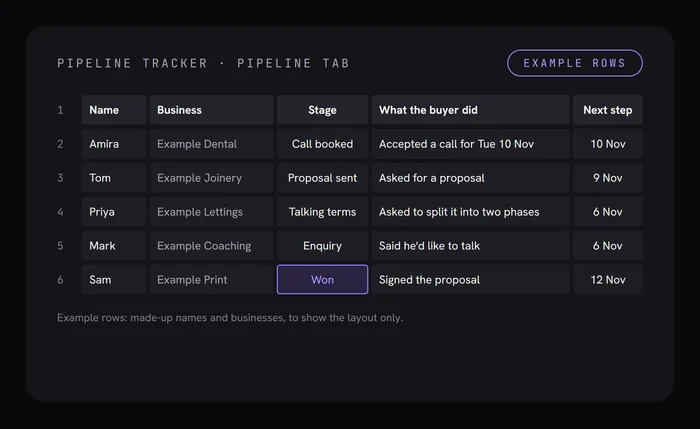
Chapters 1 and 2 are where your sales come from. Chapters 3 to 8 are the call itself, from preparing to asking. Chapters 9 to 11 are what happens afterwards.
Under each chapter: what you’ll be able to do when you finish it. Every chapter ends with a short “Do this now” list.
See why the pushy version of selling is the one to drop, and what good selling looks like instead.
List 20 people who already know your work, and reply to every enquiry that’s waiting.
Fill in a one-page call plan and go in aiming for an agreed next step with a date.
Agree what the call is for, how long it takes and what might happen at the end, including that it’s fine if it isn’t a fit.
Ask about what has actually happened, what it costs them, why now and who decides. Then listen.
Say your price plainly, once, then stop talking.
Work out whether an objection is a question, a worry or a real no, and accept the no when it’s real.
Summarise what they told you, recommend one option and ask directly. If a willing buyer stalls, make the decision smaller and safer.
Send a recap the same day, something useful within two days, a check-in on the date you agreed and a clear last message.
Define each stage by something the buyer has done, use your own numbers and look at it once a week.
Score one call a week against ten checks and practise the hard parts before they happen.

Marketing consultant with 12 years in sales. I build and run websites, search and follow-up for small UK businesses, so these toolkits are the steps I use, written down. I’ve never liked the pushy version of selling, so this is the version I’d want: honest questions, a clear price, a plain ask and no chasing.
More about meRather I did it for you? Book a free 15-minute call.
Give me your first name and the email to send it to. It’s free: no card and no trial.
The download link arrives in a minute or two, with your name on the guide and workbook covers. It works for 30 days, and you can ask for a fresh one any time.
Read the Start here page, work through the guide over four weeks, then spend 20 minutes a week on the tracker and score one call.
Tell me where to send it. The download link comes to your inbox in a minute or two, with your name on the guide and workbook covers.
Your download link for No Hard Sell is on its way to your inbox. It usually arrives in a minute or two. If it hasn’t, check spam or promotions, then email [email protected].
The link works for 30 days. After that, ask for a fresh one on the download page.
When something that matters changes, I update the files and list the change here. Your download link always gives you the latest edition.
Something else? Email [email protected] or call 07521 931159.
Yes. Every UK rule in it was checked against legislation.gov.uk, GOV.UK, the ICO and the FCA on 1 November 2026, and the date is printed in the guide. When a rule that matters changes, I update the toolkit and list the change in the Editions box on this page. Your download link always gives you the latest edition.
No. It’s for people who already know you, have enquired or have agreed to talk. Most of my phone years were outbound calls, and the lessons about conversations come from them, but if you want cold-calling scripts or lists to buy, this isn’t the kit for you.
Probably not, and I don’t think any kit can. It makes calls shorter, clearer and less awkward: ten minutes of preparation, a plain way to say your price and ask, and a way to stay in touch that isn’t chasing.
Founders of UK B2B firms of 1 to 20 people who do their own selling: consultants, trades and M&E contractors, recruitment founders and IT services firms. It isn’t for sales teams of 10 or more with a manager.
Research where it exists, and my own 12 years in sales where it doesn’t. The guide tells you who measured what and how good the evidence is. If a number is a software company’s own data, I say so, and where a point is my view, I say that too.
No. The guide has six UK rules boxes, on emailing people, what you can’t do when you ask, consumers or businesses, cancellation rights, payment plans and recording calls. Each explains the rule in plain English and links to the official page. If you sell to consumers on finance or at their home, check the official guidance.
Yes. It’s for you and your business, so anyone in the business can use it, and you can copy and print the files as much as the business needs. Please don’t share, resell or publish them outside it. The terms for downloads say the same.
Email me and I’ll fix it or send it another way. Your download link is in your email, and you can ask for a fresh one from the download page with the email address you used.
When something that matters changes, I update the files and list what changed in the Editions box on this page. Your download link always serves the latest edition, and if it has expired you can ask for a fresh one with the email address you used.
Yes. You give me your first name and an email address, and I email you the download link. No card, no trial. There’s a box to tick if you’d like occasional emails from me about marketing; it’s up to you, and you get the toolkit either way.
The free sheet is the ten-minute prep, the up-front agreement and five questions on one page. The toolkit explains every step, with the call plan and scorecard, 40 questions, 12 objections, 12 after-the-call messages, the pipeline tracker and 15 AI prompts.
The toolkit is how I’d run a sales call, written down for you to use yourself, free. If you’d rather have help with your own calls, book a free 15-minute call.
Eight PDFs and one spreadsheet. The workbook fills in on screen or prints, and the tracker is for Excel or Google Sheets. Your name is on the guide and workbook covers.
Free, 15 minutes, no pitch. I’ll search your business before we speak.
Free call with Gareth
15 minutes · Google Meet
Pick a day
Pick a time
Loading free times…
No free times in the next three weeks. Email [email protected] and I'll find one.
The invite with the Google Meet link is on its way to your inbox. I'll look you up before we speak.
Need to move it? Use the link in the invite, or email [email protected].
Rather talk now? Call 07521 931159 or email [email protected].
 Pick a time
Can I use Google Analytics cookies to see which pages help? Nothing is set unless you say yes. How I use them