TL;DR
SEO gets your pages ranked in Google. GEO gets your business named in AI answers from ChatGPT, Gemini and Google's AI Mode. Most of the work is shared. For a small UK firm, fix the SEO foundation first, then add the few GEO extras. You can check both for free: ask the AI tools yourself, and open the AI report in Search Console.
Why trust this page: I sell SEO and AI search work, so I have an interest. The figures below come from my own study of 7,952 East Anglian firms and from Google's and OpenAI's own documentation, checked on 12 November 2026. Where something is my judgement, I say so.
GEO vs SEO: what is the difference?
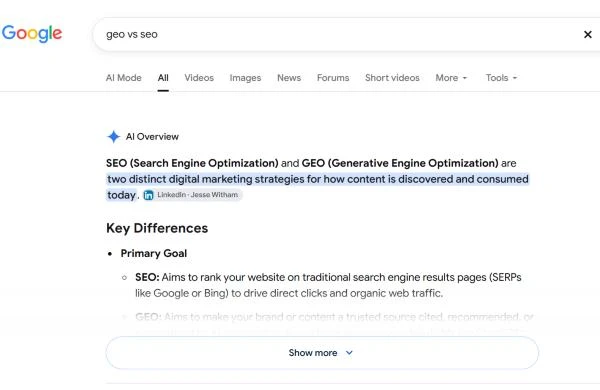
SEO (search engine optimisation) is the work that gets your pages into Google's results, so people click through to your site. GEO (generative engine optimisation) is the work that gets your business named, and your pages cited, when someone asks an AI tool a question. One aims for a click. The other aims for a mention in the answer.
| SEO | GEO | |
|---|---|---|
| The goal | Rank a page in Google's results | Get named and cited in AI answers |
| Where it shows | The list of links | ChatGPT, Gemini, Perplexity, AI Overviews, AI Mode |
| A win looks like | A click to your site | Your name in the answer, sometimes with a link |
| What it rests on | Useful pages, a sound site, links from other sites | The same, plus clear answers and mentions on other trusted sites |
| How you measure it | Search Console clicks and rankings | Search Console's AI report, asking the tools, branded searches |
| Cost to start | Your time, or a monthly fee | Mostly the same work, so little extra |
Is SEO dead now that AI answers the question?
No. Google's own guidance says there are no extra requirements to appear in AI Overviews or AI Mode beyond the basics of good SEO. In its words, "there are no additional requirements to appear in AI Overviews or AI Mode". The AI answers are built on pages Google can already find and trust. What has changed is that fewer searches end in a click, so being named in the answer matters more than it did.
The pressure is rising. Google's November 2026 core update started rolling out on 10 November, and Google has said it plans to bring ads to AI Mode in the UK this quarter, which pushes plain links further down the page. I wrote about that in ads in Google AI Mode.
What I found asking AI about 7,952 firms
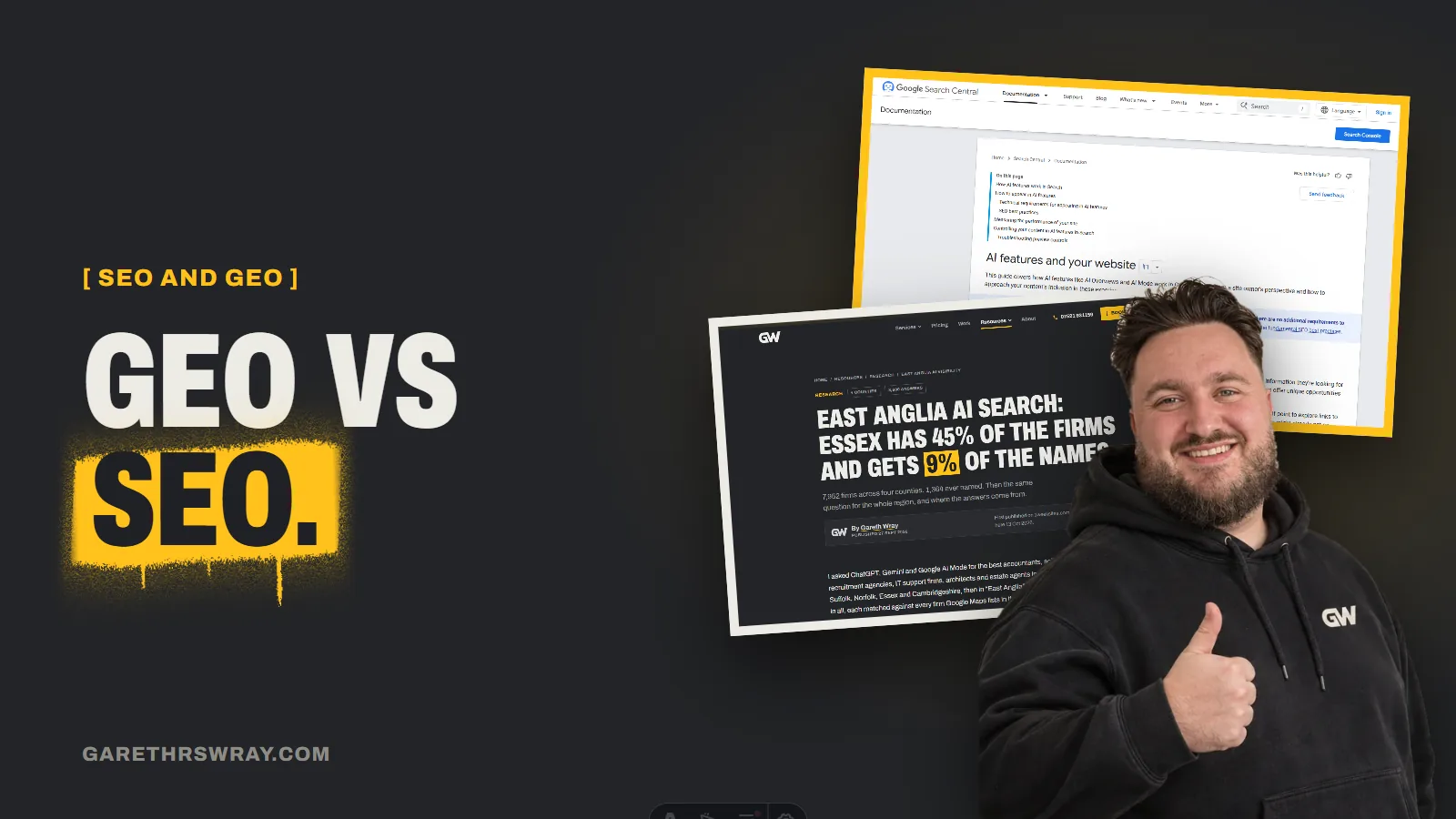
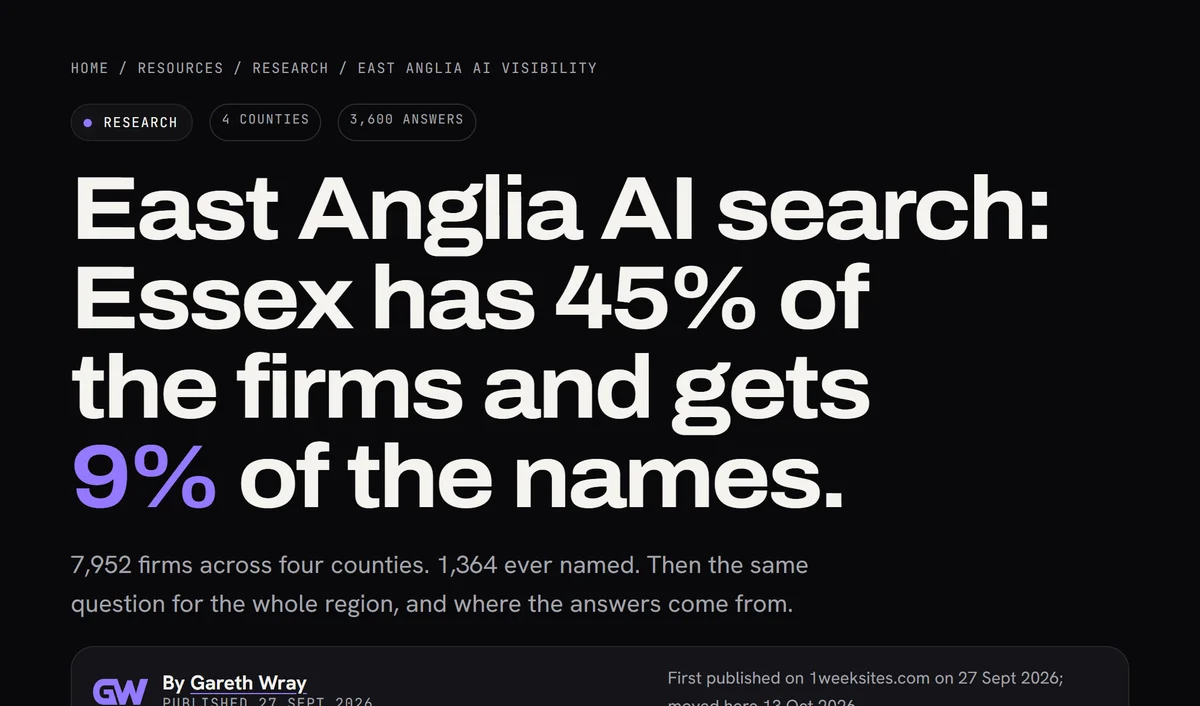
Most small firms aren't named by AI tools at all. In my East Anglia AI search study, I asked ChatGPT, Gemini and Google AI Mode for recommendations across Suffolk, Norfolk, Essex and Cambridgeshire, 3,600 answers in all. Of 7,952 firms, 1,364 were ever named. That leaves 6,588 firms that never came up once.
Suffolk on its own looked much the same: 291 of 1,253 firms were named. In separate checks on growing UK businesses in October, 22 of 35 weren't named by ChatGPT, Gemini or Perplexity. The firms that did get named usually had pages that answered the buyer's question plainly and showed up on other sites too.
The lesson for a small firm: what holds most of them back is the SEO basics and unclear information about what they do. That's good news, because both are cheap to fix.
Where they overlap, and what GEO adds
Most of the work is shared, and that's my judgement from doing both. Both need a site that crawlers can read, pages that answer real questions, and other trusted sites that mention you. GEO adds four things on top.
- Answer first. Put a plain 40 to 60 word answer under each question heading, so an AI tool can lift it cleanly.
- The same details everywhere. Your name, phone, services and area should match on your site, your Google Business Profile and directories. I've written up the checklist for getting recommended by ChatGPT.
- Mentions on other sites. AI tools lean on third-party pages: trade bodies, directories, local press, review sites.
- Let the AI crawlers in. Check your robots.txt doesn't block them. OpenAI says OAI-SearchBot is the one that decides whether your site can appear in ChatGPT search. GPTBot is only for training, so you can block that one and still be found.
What should a small business do first?
Fix the SEO foundation first, then the GEO extras. AI answers draw on pages that already rank and on mentions elsewhere, so GEO work on a weak site has little to stand on. For a firm of up to 20 people, this is the order I'd use, with rough time per month:
- Foundation (month one, about 6 to 10 hours): your site is indexed, fast and readable; each service has its own page; business details are correct everywhere.
- Answers (ongoing, about 4 hours a month): rewrite your main service pages to answer the buyer's questions first, including price where you can.
- Mentions (ongoing, about 2 hours a month): Google Business Profile, two or three relevant directories, and reviews.
- Measure (30 minutes a month): the test and the report below.
Those hours are my estimate for a small service business, not a published benchmark.
The 10-minute ChatGPT test
You can check whether AI tools recommend you, for free, in about ten minutes.
- Write three to five questions a buyer would ask, such as "best IT support company for a small office in Ipswich".
- Ask each one in ChatGPT, Gemini and Google's AI Mode. Ask each twice, because answers change from run to run.
- Write down who gets named and which pages are cited as sources.
- Repeat once a month with the same questions.

The cited pages tell you where to get mentioned. If a directory or a trade body keeps coming up, that's your next listing. I ran this on a small set of prompts in October, and ChatGPT tended to cite small service pages that printed their prices, so say what you charge if you can.
How to measure GEO for free
Start with Google Search Console. Google added generative AI performance reports that show how often your pages appeared in AI features in Search, and Google says they reached all websites on 31 August 2026. They show impressions only, so they tell you how often you were seen. Then add two more checks:
- AI referrals in Google Analytics: look for visits from chatgpt.com, perplexity.ai and gemini.google.com in your traffic sources.
- Branded searches: people who hear your name in an AI answer often search for you by name later, so a rise in brand searches in Search Console is a useful sign.
Do you need schema for AI search?
No special schema is needed. Google's guidance says there's no special structured data you have to add, and no AI text files or new markup to appear in its AI features. Normal schema still helps search engines understand your business, your services and your FAQs, so keep it, but don't pay anyone to add "AI schema".
What not to pay for
- A GEO retainer that skips the SEO basics. If your service pages don't answer the question, no AI tactic will fix it.
- Guaranteed AI rankings. Nobody controls what ChatGPT says, and answers vary between runs.
- AI visibility trackers before you have the pages. The free test above tells a small firm most of what it needs.
- "AI-optimised" content at volume. Google's guidance warns against mass-produced pages made with little effort, and a small firm's best asset is first-hand experience.
One honest note on the research: the academic paper that coined GEO found that certain changes could boost visibility by up to 40% on its test set. That was a research benchmark, not results for real businesses, so be wary of anyone quoting it as a promise.
The practical summary
GEO and SEO are one job with two outputs. Get the foundation right, write pages that answer the buyer's question plainly, keep your details the same everywhere, and get mentioned on a few trusted sites. Check yourself in the AI tools once a month and watch Search Console's AI report. If you'd like it done for you, see my SEO services, or start with the guide to what SEO costs in the UK.
Fair questions
What does GEO vs SEO stand for?
SEO is search engine optimisation: getting your pages to rank in Google's results. GEO is generative engine optimisation: getting your business named and your pages cited in AI answers, such as ChatGPT, Gemini, Perplexity and Google's AI Overviews and AI Mode.
Is GEO the same as AEO?
Close enough for a small business. AEO (answer engine optimisation) and GEO both mean shaping your content so AI tools and answer boxes use it. Agencies use the labels differently. The work underneath is the same: clear answers, consistent facts about your business, and mentions on other trusted sites.
How long does GEO take to work?
Expect weeks to months, the same as SEO. AI search tools lean on pages that are already indexed and on mentions elsewhere, so new pages and listings need time to be found. Quick wins are fixing wrong business details and adding clear answers to pages that already rank.
Can a small business do GEO without an agency?
Yes. The free test and the Search Console report in this article cost nothing, and most of the work is writing clear answers about what you do, keeping your details consistent and getting listed on relevant directories. Pay for help when you don't have the hours, not because GEO needs special tools.
Does Google penalise AI-written content?
Google judges the content, not how it was made. Its guidance warns against mass-produced pages with little effort or originality, and against made-up author profiles. AI-assisted writing that a real person checks, with first-hand experience in it, is fine.